

Planning a corporate virtual run may seem simple from the employee's perspective—register, walk or run, track progress and contribute to a shared company goal.
Behind the scenes, however, HR teams need to coordinate campaign objectives, participation rules, tracking methods, communications, participant support and reporting. Proper planning helps create a smooth employee experience while reducing administrative workload.
This guide provides a practical framework for organising a corporate virtual run in Singapore or across a regional workforce.
Begin by deciding what the company wants the virtual run to achieve.
Common objectives include:
Choose one primary objective so employees clearly understand the purpose of the campaign.
Example:
Our four-week virtual run will bring employees across Southeast Asia together to complete 30,000 kilometres and unlock a company donation for our regional charity partner.
Before planning the event, understand your participants by considering:
Removing participation barriers helps improve engagement and inclusivity across the organisation.
Allow both walking and running whenever possible. Combine different participation goals such as:
A three- to four-week campaign provides enough flexibility while maintaining momentum.
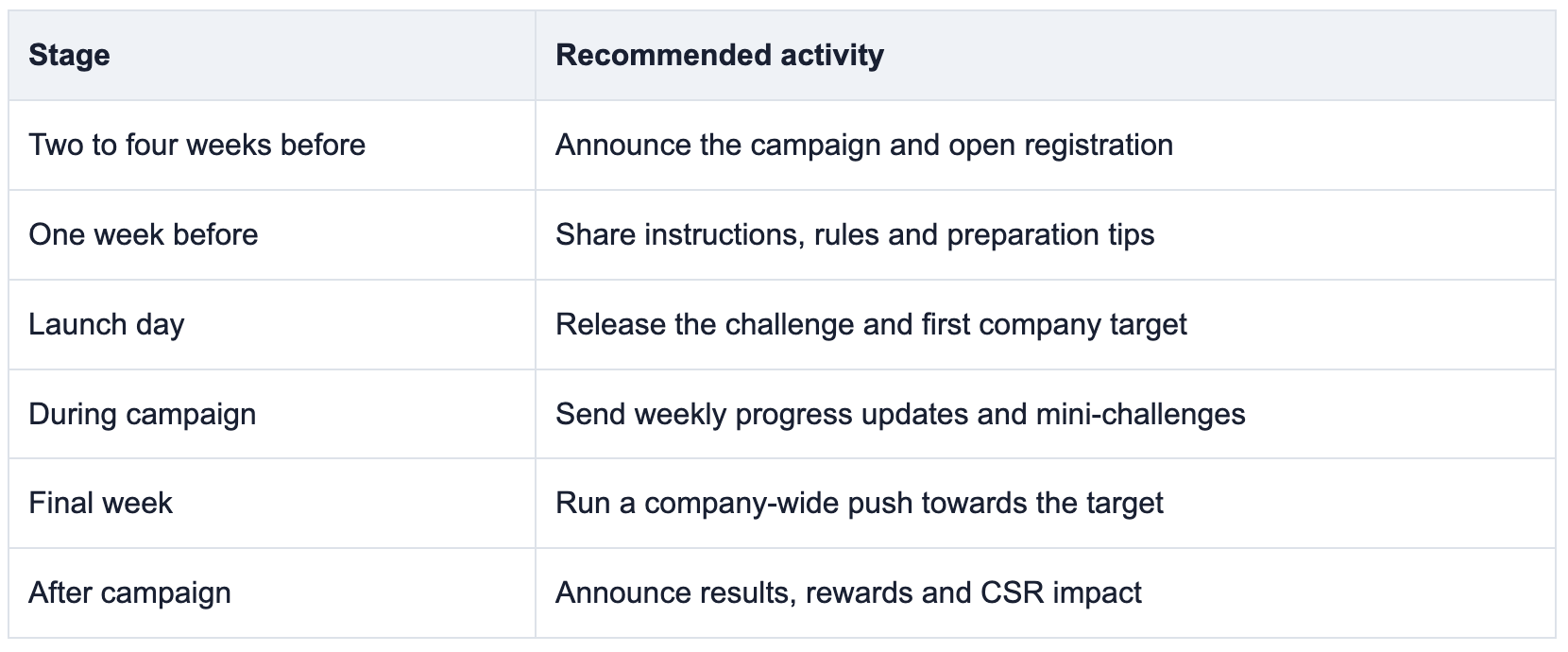
Recommended schedule:
Participants may submit activities through:
Ensure the provider clearly explains supported devices and verification methods.
Popular team formats include:
Consider ranking teams using participation rate or average distance instead of total distance to keep competitions fair.
Reward more than just top performers.
Examples include:
Meaningful recognition often motivates employees more effectively than expensive prizes.
Prepare communications before launch.
Suggested campaign communications:
Consistent communication helps maintain engagement throughout the campaign.
A CSR component adds purpose to the campaign.
Common approaches include:
Clearly communicate:
Evaluate providers based on:
The best provider reduces HR workload while creating a smooth participant experience.
Track metrics that align with your objectives.
Examples include:
The best corporate virtual runs appear simple because the planning has already been completed behind the scenes.
By setting clear objectives, designing an inclusive experience, communicating consistently and recognising participation, companies can create an engaging programme that supports employee wellbeing and meaningful connections across the organisation.

There is no universal target. Set achievable milestones and allow walking where possible.
Consider participation rate, average distance and milestone completion alongside total distance to create a fairer competition.
Allow sufficient time for planning, approvals, platform setup, communications and testing—especially for regional campaigns.
Agree on correction and verification procedures with your provider before launch and communicate them clearly to participants.

Plan a virtual run in Singapore that connects employees, supports wellness and gives HR measurable participation across teams and offices.
Discover the top virtual races in Singapore that you can join this year.
Build a programme around your workforce size, locations, engagement goals and CSR priorities.


