First-time organisers often make the same mistake: sending every team off from the same starting line along one linear sequence of stops. Within minutes of flag-off, what was meant to feel lively turns into a queue at the opening checkpoints, with teams watching each other solve the exact same clue. For HR managers and internal team leads working within a tight half-day schedule, participant flow matters more than elaborate props. Good flow comes down to four practical decisions: route geometry, mixed-ability tasks, checkpoint operations, and weather-ready logistics.
Linear routes cause two immediate headaches: early bottlenecks and answer-copying when teams catch up. Instead, build a non-linear loop or hub-and-spoke layout where teams can tackle checkpoints in different sequences before converging at a common finish.
Pair that layout with staggered starts. Dispatching waves a few minutes apart, or assigning separate starting checkpoints to different clusters of teams, spreads participants out before the first clue is solved. In practice, once teams lose sight of the group ahead, navigation and genuine teamwork take over.
If your corporate amazing race rewards pace alone, non-runners and staff who prefer low-impact movement will disengage early. Strong route design limits the speed advantage by rewarding different strengths at each stop:
When points come from accuracy, creativity, and completion rather than sprinting, mixed-ability teams naturally stay together.
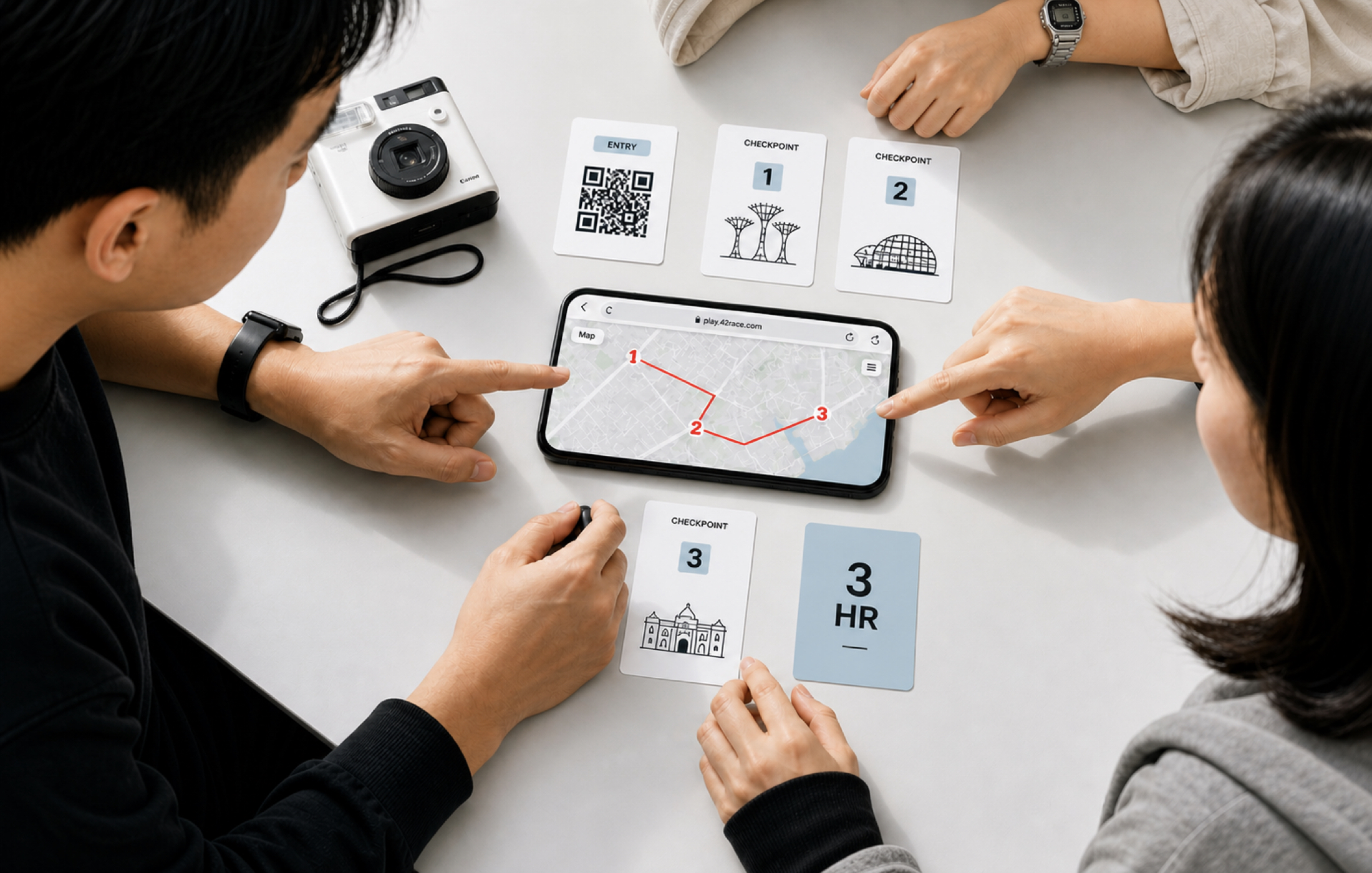
Staffed stations bring human energy and can host tactile mini-games, yet they are also where queues build fastest if several teams arrive together. QR or code-based checkpoints remove that wait by letting teams unlock clues and submit answers directly in a mobile browser at their own pace.
Remember what digital checkpoints do and do not cover: QR codes provide browser access and task progression, not GPS verification or live location monitoring, so presence is confirmed through site-specific clues. Where digital tools genuinely help is event administration—using a platform like 42Race lets a lean organising team manage scoring rules, live leaderboards, and gamemaster review of photo or video submissions without tallying spreadsheets at the finish.
Once briefings, refreshments, and a wrap-up are factored into a half-day corporate slot, active time on foot is shorter than most organisers expect. Keep total walking distances modest and comfortable for mixed-ability staff, with shaded rest points and easy access to water.
In Singapore, midday humidity and sudden downpours can derail an exposed route quickly. Prioritise sheltered linkways and connected indoor concourses when mapping stops, and prepare a wet-weather fallback for exposed checkpoints. Before locking in your clues, walk the route at the same time of day your staff will race to test every sheltered link.
Mix departments, roles, and energy levels rather than letting close cliques or office runners cluster together. Balanced teams prevent one group from turning the race into a sprint while giving quieter staff room to shine on puzzles and creative missions. Confirm any accessibility needs privately during registration so routes remain comfortable for everyone.
Keep the pre-race briefing focused on three essentials: accessing clues, scoring rules, and the cut-off time to return. Share login instructions a day earlier by email or chat so teams are not troubleshooting phones at the start line. A crisp send-off gets groups moving while energy is high.
Avoid making finish order the primary scoring driver, as speed bonuses quickly turn an inclusive event into a footrace. Tie points to puzzle accuracy, creative mission quality, and checkpoint completion, applying late penalties only after the cut-off. That keeps every team engaged until the finish rather than rushing past challenges.
We help HR and event teams design non-linear digital or hybrid Amazing Races with smooth checkpoint progression, live leaderboards, and gamemaster support tailored to your venue and headcount.
BOOK A DEMO
Virtual race offers a flexible, stress-free alternative to traditional running events by allowing participants to complete races at their own pace, on their own schedule.
Practical, operational guide to designing an Amazing Race-style event for corporate teams: goals, format choices, logistics and inclusion.